

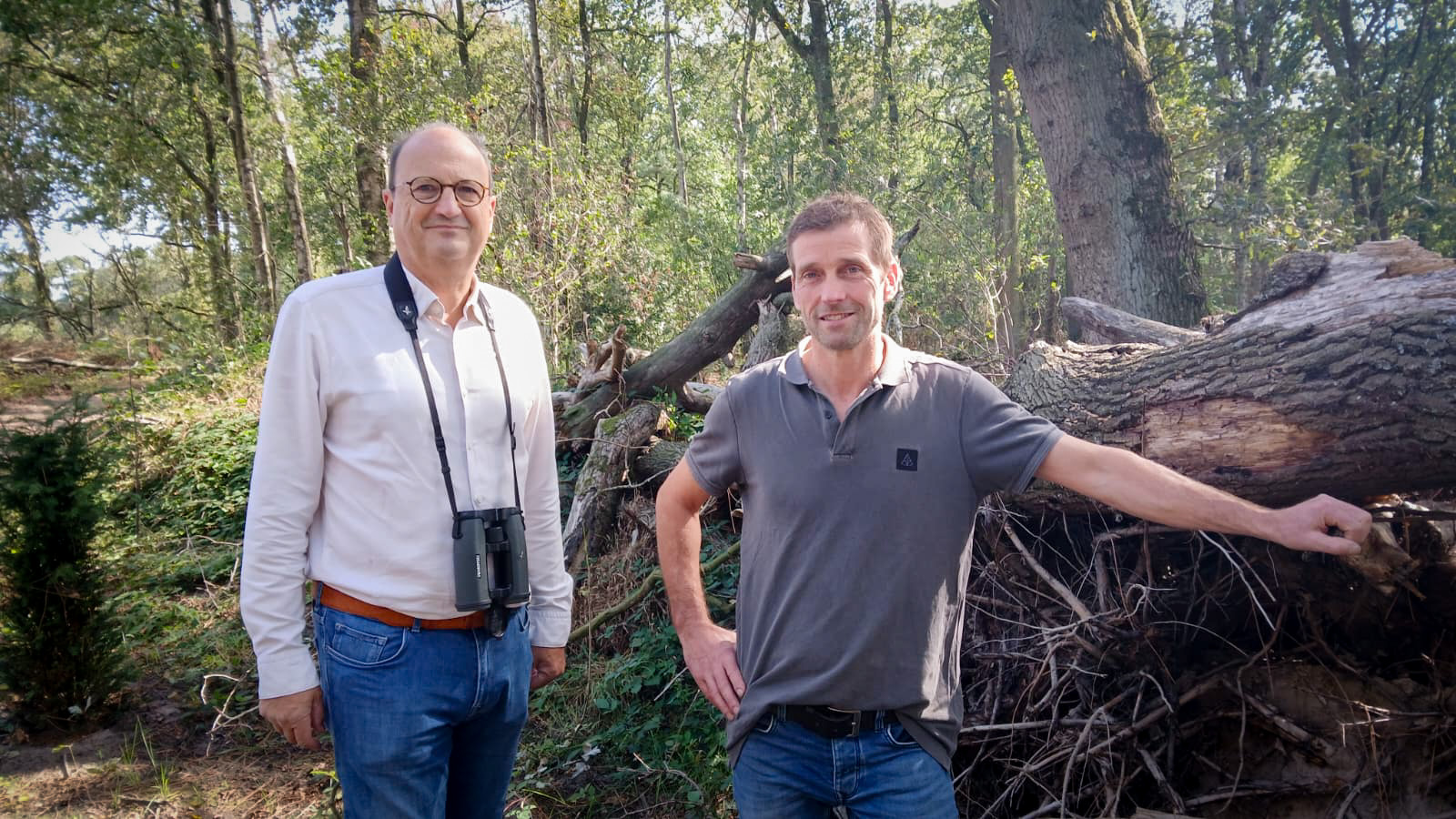
Within the Grenspark Kalmthoutse Heide , private landowners, land management organisations and local authorities are working together to create a strong and biodiverse landscape. A fine example of this can be found on the private Groote Meer estate in Ossendrecht, where owner Jean-Benoît Cogels and manager-adviser Anton Vos are working to create a woodland that is more resilient to climate change, drought and nitrogen.
Management at Groote Meer is carried out in various ways, each with its own long-term objective.
For example, rhododendrons are being removed, as they threaten to crowd out other plants and animals. New trees are being planted in the spaces they leave behind: different species are deliberately mixed, with a view to creating a woodland with greater variety in species and ages. This makes the woodland more resilient to the effects of climate change.
Prunings are also given a new lease of life. Instead of being disposed of, they are turned into brushwood piles. These provide shelter and food for insects, rodents and other species, thereby contributing to biodiversity on the estate.
In addition, work is underway to improve resilience to wildfires: fire brigade access routes have been widened and cleared, so that the area can be reached more quickly and safely in the event of an emergency.
Groote Meer plays a key role in the wider ecosystem of Grenspark Kalmthoutse Heide. The estate is situated on the Brabantse Wal and acts as an infiltration area: water that falls here begins to find its way downwards from this higher-lying area.
Part of the area is not accessible to visitors: the ecologically sensitive core is closed off. This closed-off core provides the necessary tranquillity for species that are sensitive to disturbance. At the same time, it is possible to walk all the way round the area, and the training ground is also open to the public. In this way, the significance of this private management extends beyond the boundaries of the estate itself.
What is happening at Groote Meer demonstrates how targeted management can serve several objectives at once: a forest that is more resilient to climate change and drought, a landscape that is more resistant to wildfires, and an area that remains accessible to walkers. An inspiring example of how private nature conservation contributes to a resilient and accessible landscape.
Journalist Vincent Krijtenburg visited the site and captured the story in a lovely feature for ZuidWest Update. Read the full story.
ZuidWest Update